

Trying to start a gas fireplace but not sure which switch, knob, remote, or key to use? You're not alone. Gas fireplaces use different ignition systems, so the right way to start yours depends on the controls you have.
Once you identify how your fireplace is controlled, the basic process is usually straightforward. Always follow the instructions for your specific model, and if you smell gas, don't try to light the fireplace.
At No Worriez, we spend a lot of time thinking about what happens after a gas appliance is turned on—especially how and when the gas gets shut off. This guide covers the full process, from starting your fireplace to troubleshooting and shutting it down safely.

Before You Start: Know How Your Gas Fireplace Turns On
Before touching any controls, find out how your fireplace is designed to start. Different models may use very different controls, and instructions that work for one fireplace may not apply to another.
A quick look at your fireplace can usually point you in the right direction:
| What You See | How It Usually Starts |
|---|---|
| Wall switch | Wall switch / electronic ignition |
| Handheld remote | Remote control |
| OFF / PILOT / ON knob | Pilot-light control |
| Fireplace key | Key-operated gas valve |
| Not sure | Check the fireplace model and manual |
Different models can use different starting procedures.
Your owner's manual should always take priority over general instructions online. If you can't find the manual, look for the manufacturer and model number on the unit and check the manufacturer's website.
Before lighting the fireplace, also take a quick look around it. Keep combustible items away from the unit and make sure nothing appears damaged or out of place.
Most importantly, do not attempt to light a fireplace if you smell gas.
Because gas fireplaces are fuel-burning appliances, carbon monoxide safety matters too. The U.S. Consumer Product Safety Commission recommends having home heating systems, including chimneys and vents, inspected annually by a trained service technician and installing CO alarms on every level of the home and outside sleeping areas.
Read More: Protect Your Family from Carbon Monoxide Poisoning (recommendation from CPSC)
How to Start a Gas Fireplace?
Once you've identified the controls, starting a gas fireplace usually means activating the wall switch or remote, or following the pilot/key lighting procedure specified by the manufacturer.
The exact sequence varies by model, so use the following as a guide—not as a replacement for your fireplace's instruction.
1. How to Start a Gas Fireplace With a Wall Switch
If your fireplace has a wall switch, it may use an electronic ignition system.
Make sure the fireplace is in its normal operating mode, then flip the designated wall switch to the ON position. The ignition system should start the main burner automatically.
If nothing happens, don't keep flipping the switch repeatedly. Check the fireplace controls and operating mode first, then refer to the troubleshooting section below.

2. How to Start a Gas Fireplace With a Remote
Some gas fireplaces can be controlled almost entirely by remote.
Make sure the fireplace receiver is in the correct operating mode, then use the ON function on the remote. Depending on your model, the remote may also control flame height, temperature, or timer settings.
If the fireplace doesn't respond, start with the simple things: check the remote batteries and make sure the receiver and remote are set to the correct mode.

3. How to Start a Gas Fireplace With a Pilot Light
If you see a control knob marked OFF, PILOT, and ON, your fireplace may use a pilot-light system.
Start by locating the fireplace's pilot controls. Follow the manufacturer's instructions to place the control in PILOT mode, then use the built-in igniter, if equipped, while holding the pilot control as directed.
Once the pilot flame is stable, follow the manufacturer's instructions to move the fireplace into its normal operating mode and turn on the main burner.
Avoid relying on a universal rule such as “hold the knob for exactly 30 seconds.” Ignition procedures and timing can vary between fireplace models.

4. How to Start a Gas Fireplace With a Fireplace Key
Some gas fireplaces use a removable fireplace key to control gas flow.
Locate the key valve, which may be in the wall or floor near the fireplace. Before opening the gas supply, check the manufacturer's lighting instructions for your specific fireplace.
Follow the specified lighting sequence and confirm that the flame is stable once the fireplace is running. Don't allow gas to continue flowing while making repeated unsuccessful attempts to light the fireplace.
Gas Fireplace Won't Start? Check These First
Sometimes the real reason you're searching for how to start a gas fireplace is that you've already tried—and nothing happened.
Before assuming something is broken, identify exactly what the fireplace is doing.
| What Happens | What to Check First |
|---|---|
| Wall switch does nothing | Fireplace operating mode / controls |
| Remote doesn't work | Batteries / receiver mode |
| Pilot won't light | Lighting procedure / gas supply status |
| Pilot lights but won't stay lit | Stop repeated attempts; inspection may be needed |
| Igniter clicks but no flame appears | Follow manufacturer troubleshooting guidance |
| You smell gas | Stop and don't attempt ignition |
When to Stop Troubleshooting for Gas Fireplace
If the fireplace repeatedly fails to ignite, the pilot won't remain lit, you suspect a gas-supply problem, or any controls appear damaged, it's time to stop troubleshooting and contact a qualified fireplace or gas professional.
Don't disassemble a gas valve, modify a gas line, or bypass a built-in safety device just to get the fireplace running.
The same principle applies to installing gas-control equipment. No Worriez recommends having gas connections made by a professional gas installer and specifically points customers toward qualified gas specialists for installation work.
-
Gas Grill Shut Off Timer - With 3/8" Flared Assy.
Regular price $116.00Regular priceUnit price per$128.90Sale price $116.00Sale -
Gas Grill Shut Off Timer - 1/2" NPT Female (Red)
Regular price $89.99Regular priceUnit price per$116.00Sale price $89.99Sale -
Gas Grill Shut Off Timer-With 3/8" Flared Flex Assy.
Regular price $121.00Regular priceUnit price per$134.50Sale price $121.00Sale -
Gas Timer Duo w/Bypass, hose assembled 3/8" Flared Kit
Regular price $141.90Regular priceUnit price per



Starting the Fireplace Is Only Half the Job
Getting the flame started is only half of safe fireplace operation. Knowing what happens when you're finished is just as important.
This is where three terms can easily get mixed together:
Turning off the burner is not necessarily the same as turning off the pilot or shutting off the gas supply.
At No Worriez, this is the part of gas appliance use we pay particular attention to: what controls the gas after the appliance has been turned on?
How to Turn Off a Gas Fireplace Correctly and Safely
For normal use, many gas fireplaces allow you to turn off the main burner using the same wall switch, remote, or control used to turn it on.
What happens after that depends on the fireplace. Some systems may keep a pilot operating, while others use electronic ignition.
Before walking away, make sure the main flame is completely out and the fireplace appears to have shut down normally.
This becomes especially important in shared spaces. At home, you may know exactly who last used the fireplace. In a vacation rental, resort, or other managed property, the person who turns on a gas appliance may not be the person responsible for checking it later.
And that raises another question.
What If You Forget to Turn Off the Gas?
Different gas appliances use different types of controls, and some modern fireplaces already include built-in timers or automatic shut-off features. Others rely more heavily on someone remembering to turn the appliance off.
It also helps to understand that different controls solve different problems:
| Control | What It Does |
|---|---|
| Flame-sensing control | Responds when flame is lost |
| Built-in timer | Shuts down according to the fireplace's programmed operation |
| Manual shut-off | Depends on the user |
| Mechanical gas timer | Limits gas-flow duration on compatible installations |
Does Your Gas Fireplace Have an Automatic Shut-Off?
Before considering anything additional, check what your fireplace already does.
Look at the owner's manual for features such as:
- automatic shut-off
- timer mode
- thermostat control
- safety shut-off
- flame-sensing protection
What If Your Gas Fireplace Doesn't Have a Timer?
For a compatible gas installation without a built-in timer, an external mechanical timer is one option for limiting how long gas can remain on.
This is where a No Worriez gas timer can come in.
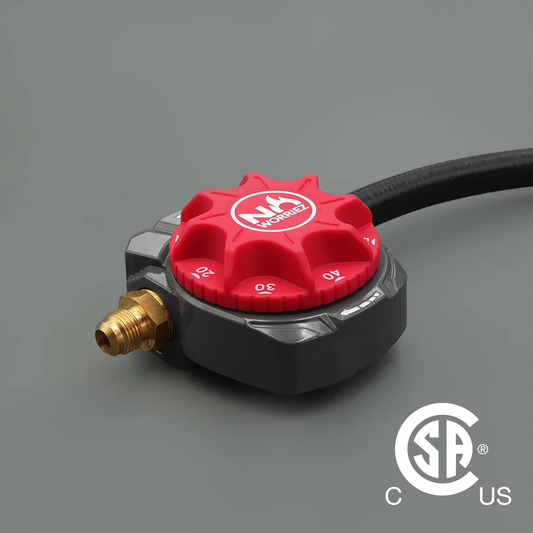
For example, the No Worriez DUO Series is a 100% mechanical device that requires no batteries. In timer mode, the preset 0–60 minute timer automatically stops gas flow. It also includes a bypass mode for continuous gas supply when timed operation isn't appropriate. No Worriez currently lists the DUO for applications including fireplaces, fire pits, and BBQ setups.
That doesn't mean every gas fireplace should have one.
Compatibility matters. Gas type, pressure, BTU requirements, connection size, appliance specifications, location, and installation requirements all need to be considered before adding a gas-control device. The DUO, for example, has specific connection and capacity specifications, so suitability should be confirmed rather than assumed.

Timed Shut-Off for Shared and Managed Spaces
A timed shut-off becomes particularly worth considering when more than one person may use the same gas appliance.
Think about a vacation rental with changing guests, a shared outdoor fireplace, a resort common area, or a managed property where staff can't always know who used an appliance last.
In these situations, the issue isn't necessarily that users don't know how to turn the gas off. It's that consistent shutdown depends on many different people remembering to do it every time.
A compatible timed shut-off adds another way to manage that part of the process.
For contractors, installers, and property professionals, it's worth thinking about gas shut-off controls during the planning stage—not after the appliance has already been installed.
Make Shut-Off Part of the Plan
Knowing how to start a gas fireplace is useful. Knowing how the gas is designed to shut off is just as important.
For compatible fireplaces, fire pits, outdoor kitchens, and shared-use gas applications, No Worriez mechanical gas timers offer timed shut-off without relying on batteries. If you're planning a new installation or managing gas appliances across multiple properties, start by checking the appliance and gas-system requirements to find the right setup.
| Feature | ||||
|---|---|---|---|---|
| Best For | Fireplaces / Fire Pits / BBQ | Commercial Kitchens / Heavy-duty Equipment | Gas Grills / Residential Use | Outdoor Cooking / BBQ |
| Timer Function | Bypass Function | Bypass Function | Standard Gas Timer | Standard Gas Timer |
| Time | 1hr | 1hr | 1hr-3hr | 1hr |
| High Pressure Capacity | — | ✓ (5 PSI) | — | — |
| Max. BTU Input | 80,000 B.T.U./hr | 100,000 B.T.U./hr | 100,000 B.T.U./hr | 100,000 B.T.U./hr |
| Connection Size | 3/8" | 1/2" | 1/2"-3/8" | 1/2"-3/8" |
| Connection Type | Female-Male | Female | Female-Male | Female-Male |
| Installation Professional Skill | — | ✓ | — | — |


